Monday, 24 August 2020

The Grey Boxes

 Just noticed a couple of entries about the contents of the trackside cabinets and the batteries inside the new grey boxes which NC is installing at the moment.

 The grey boxes have been tumbling off the production line in my garage for some time. They are based on a proven, reliable system which I developed a decade ago for the new signal box at Gotherington.  Here is a brief description of how it works.

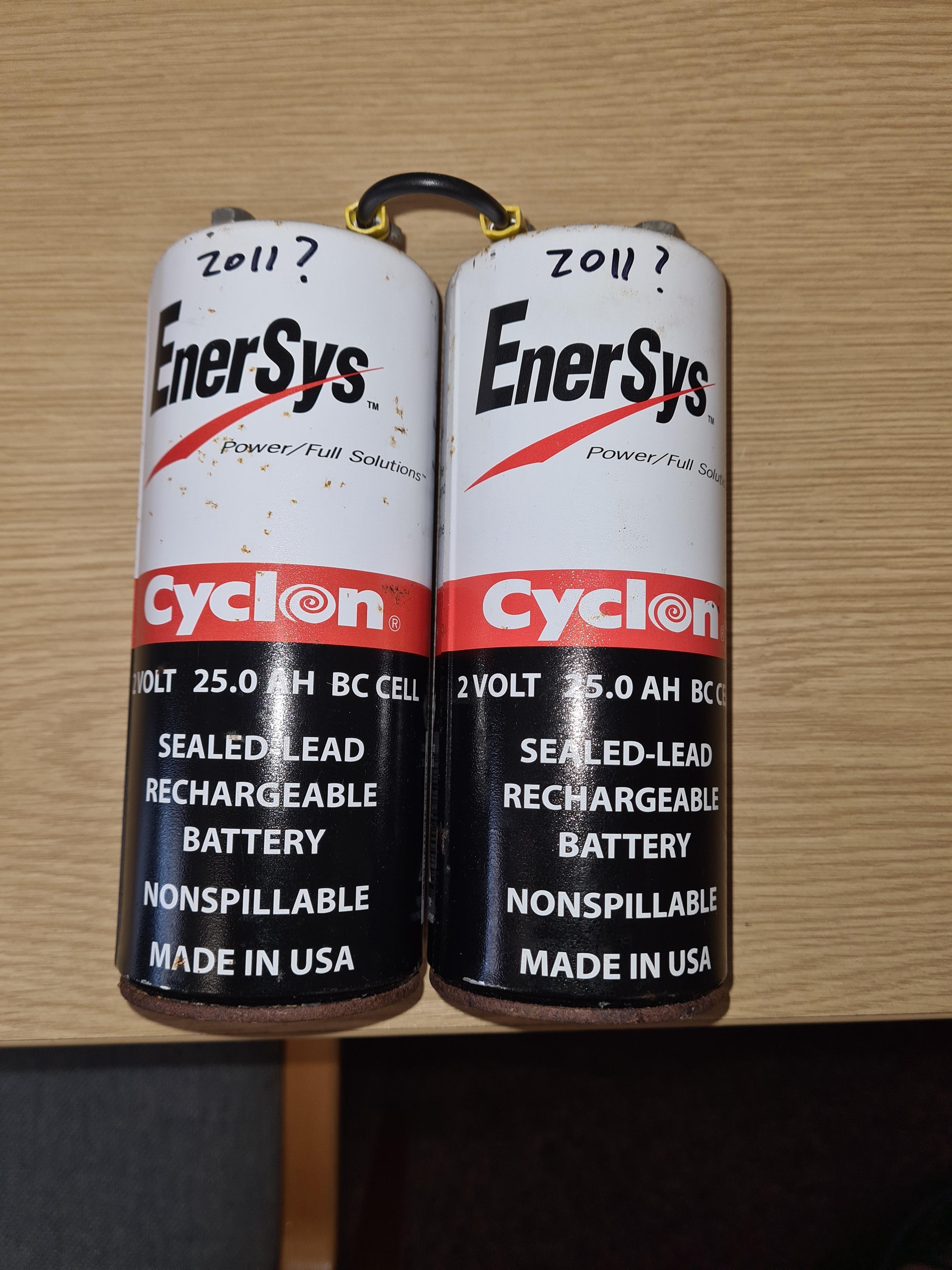
 The box contains two Cyclon 2V 25AH batteries which are the heart of the track-circuit system. They are extremely rugged and compact. When  properly looked after they have a minimum, 10 year maintenance-free life. NC's recent tests on some of the oldest batteries we have, show that they are still in excellent condition after years of trouble-free service.

The batteries are kept at a steady 2.25V per cell by a simple electronic regulator which is also in the grey box. The normal feed to the track circuit is therefore 4.5V. The regulator's input normally is 48V, fed down a pair of wires from the signal box. In the event of a supply failure the batteries are capable of maintaining the feed to the track circuits for several days. When the supply is restored the regulator recharges the battery.

 NC's plan is that the grey boxes eventually will replace the variety of  track circuit supplies currenly installed along the length of our railway. 

 The production line is still open!

Kevern 24/08/20

.


Friday, 7 August 2020

Strowger lives on!

 Just a quick note to say that yesterday I visited site and ran a set of test calls which fully utilise the system - just to be sure that it wouldnt cause a problem wth the preparations for reopening which start tomorrow with the test trains.

 Delighted and quite proud to say that all appears well

 Strowger lives on!


 Mike S

Monday, 3 August 2020

Pax Problems for Nerds v2- Solved

We had come to the conclusion that the problems were not necessarily obvious from the diagram so we had to think outside of the sheet of paper.
 Bank cleaning was well overdue and we wondered what effect sticky banks would have on the release process- was this allowing something to go out of sequence?, not a situation that I have ever met before.

 So off we set with a manual bank cleaner and yellow tape, doing three banks for now just as a trial. +
Also, whilst the selectors were jacked out it was a chance to look at lubrication particularly around the shaft area. I have long believed that with older kit its best not to fiddle with it any more than you have to- indeed AT&E later discontinued all routines as they found they introduced more faults than they cleared. I understand that the GPO also took the same view in later years (1970's).We then busied the selectors that we hadn't serviced and low and behold the fuse blowing ceased as did other odd symptoms.

The problem then settled down to permanent engaged on the first tie line. AT&E called it the D wire (aka PO P wire) to test for line engaged or free. We should therefore have tested a 150ohm battery condition on Tie line 1  but we didn't. We did on Tie 2 but not Tie 1
 
All the time we kept going back time and again to the same question "  what had changed since shutdown"

Problem solved
The wire in the loom between the resistor and bank outlet 19 was dis!

Possible reason
Perhaps the current surge which was causing the fuse to blow finally burnt an air gap in a crack in loom?? and standing for three months  allowed it time to oxidise and go HR?
 Who knows, but we left it all working once again.

Next Visit: Bank Cleaning and lube check

Mike  Stephenson and Paul Dinucci
S&T

Thursday, 16 July 2020

PAX Problems- a report for Strowger Nerds

No pictues I am afarid, the pax units have always looked the same!

Tuesday July 7

Paul and I had been called in to investigate a alarm caused by a blown fuse on the Winchcombe Pax and also a lack of dialling tone at Todd pax.
These two Strowger Paxes' were built by AT&E of Liverpool in the 1960's so they are a bit vintage.
They allow phone calls from all over the network but they seem to be used mostly for stations to report train departures up to Toddington using the 2 tie lines provided in each direction.
 Unfortunately the blown fuse had locked out the line circuits supplying all four tie lines!

Friday July 10

Off to Todd to look into the "missing Dial tone" and hoping that the problem was not to do with the tone generator.
 Although these are standard PO Ringer 2a's, the way they have been grafted into the AT&E units is non standard and we have no diagrams for that part of the arrangement.
 Interestingly, the original vibrator generator is still there in position ( they were used as standard in smaller systems such as UAX 12's)
The report was correct, there was no Dial Tone, because there was no start signal to the ringer, but why?.
These units were never fitted with malfunction alarms ie release or fuse alarms ( Winchcombe does have a visible fuse alarm system since it can be checked more easily from the yard). In the event of a rotary magnet being energised for two long, a relay which has specially wound coils would operate  and reduce the magnet current to a safe level. However what had happened was that due to a recurring line fault, the rotary magnet fuse on every selector had blown, leaving them all "off normal". Since there were no other selectors to seize the whole unit had come to a standstill!

So having got Todd pax working again it was back to Winchcombe to see what was happening there. We found that the fuse blowing was only on the first tie line!  We have had to leave that "busied " for now awaiting out next visit. This was 19 so 10 is still available for calls from Winchcombe area towards Todd.
 Watch this space, if you are still awake! Next visit  on  Tuesday 21st 

Mike Stephenson and Paul Dinucci

Tuesday, 30 June 2020

Cabinet Update

Tuesday 30th June

Hope I'm not overloading you with lineside cabinet stuff, but here's another transformation courtesy of Neil C. 
This is the before and after of the cabinet at signal 25 at Toddington:


All cabinets between Far Stanley and Toddington have now been serviced and painted. So we should have a reliable system when we run. 
All signal box equipment will need to be tested in due course - including the checking of every nut, bolt and split pin, etc - several days work I'm sure. 


No more cabinets for now! 

Curly

Monday, 15 June 2020

Track Circuit Batteries

Monday 15th June

Courtesy of Neil C here is the answer to a previous blog question regarding the "white box" in the lineside cabinet. Inside there are two 2v  25AH cells, a float charging circuit and the track feed resistor.

Having seen a picture of the rails on one of the other blogs there appears to be a good coating of rust - I suspect a bit of running will be required to get the circuits working effectively. 

These are the cells:


Hope you enjoyed this exciting blog! 

Curly


Sunday, 7 June 2020

Excellent Metalwork

Sunday 7th June

And now for something completely different 
which I would like to share. 
In Pershore we have a blacksmith who has constructed some excellent metalwork for various buildings in the town. The one which I am particularly impressed with is a memorial to horses which were used in both world wars. 
The horse in the picture below is almost completely constructed from horseshoes welded together. The attendent soldier is fabricated from sheet metal. Both of these are pretty realistic.


If you are likely to visit Pershore I would recommend a having a look at this in the Abbey Park.
Hope this distraction from railway matters gives a little light relief!

Regards to all

Curly